
Dear CCW family,
Sereno Dwight said of his great-grandfather, Jonathan Edwards, that “he had studied theology, not chiefly in systems or commentaries, but in the Bible.”
I have a true affinity for this practice, and recommend it for anyone who wants to know theology.
We should care about theology, that is, the view one arrives at when looking at what God has said broadly and more comprehensively concerning this or that biblical issue, such as justification, sanctification, the deity of Jesus, prayer, church leadership, marriage, and many more important matters. When you read a Christian book on a topic, typically you are reading a theological perspective on the subject, even if it is simply arranged in plain and understandable language and well illustrated. Theology is important. We cannot avoid it. And we are naturally inclined to collect and organize our thoughts. We want to be able to answer the question, “What do you believe the Bible says about _______?”
There are numerous aspects of theology to think about, such as the practice of doing either “biblical theology” or “systematic theology” and how they blend or counter each other. There are theologies arising from opposing presuppositions, such as Arminian Theology and Reformed Theology, to speak of one common divide. All of this means that we have to be aware as we read of what the presuppositions are that help form the writer’s theological perspective.
All the above aspects of theology are important, but I’ll cut to the question that is most important: How can we have sound theology?
My simplistic answer is to follow Edward’s lead and read your Bible deeply and repeatedly, develop your way to note or mark what you find, and come to (write out?) conclusions after you have read enough to believe you have God’s mind. Do this prayerfully. If you teach others, even your family and church, teach what you know and do it convincingly. Yet, remain humble and open as the years go on, because further Bible reading will conform you to truth even more as you go along. This all is much further helped along by discussing findings with others who have wisdom and also study the Bible, especially in your church. If some conclusion seems too odd, talk with wise people first such as your pastor to help you be sure of your findings. But we will have some differing conclusions at times, held with conviction. I differ with Edwards, for instance, on some critical issues. To be in a church with conscientious teachers and to have a group of friends meeting together to discuss and wrestle through issues is pure gold, if they are spiritually minded and prayerfully desire truth above all. And to have a spouse who will talk things out and is also in the Bible, really helps. Our lives and doctrine are shaped by these things.
I prefer this method because: 1. It has value for all of us. 2. Discovery means joy. 3. Meditation on Scripture shapes our minds and hearts immediately. 4. What we learn impacts our discussions and teachings. 5. Such reading, meditating, and marking factors into our sanctification longterm.
Reading his writings, we know that Edwards at times mentioned a perspective of other teachers, but most of his writings reveal that he was an originalist in the sense that he aimed mainly to be influenced by saturating his mind with Scripture and mining its precious metals, even if those he respected as teachers had different viewpoints. He took copious notes on Scripture and organized his thoughts as he read to preserve his findings. As a result, he took readers deeper and unveiled meaning as one with remarkable eyesight.
Again, all of this is not to say that books with theological perspectives and dialogue throughout church history are unimportant. God does call people to teach and persuade. Be one who goes to the source as your main method, however. Get used to looking at an open Bible. The answers are there. Meditate on Scripture and you will be a guide to others when God wants to use you.
My Granddad Carter
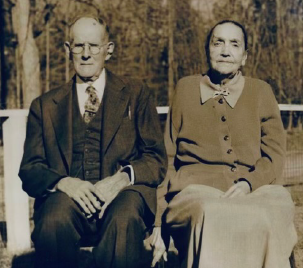 Let’s bring this home. My grandfather, born in 1870, was a deep reader and meditator on the Bible. He was a busy man, with 10 living children to take care of, a farm to run, a surveying job, and a county judge responsibility at various times. And it was their habit to invite the entire church over to their house on Sundays! He was 78 when I was born. He lived 20 more years, so I got to know him at an important time for me. He had the highest integrity.
When we would visit “down home” as mother called it, Granddad was already plagued with hearing loss. As sounds got muddled with so many cousins around, he would have to stop, sit down in his oak rocker, and read — read his Bible, I mean. That’s a memory that is important.
When attending a funeral some time after his death, a pastor of good repute in the surrounding towns cornered me to say this, “Of all the theological teaching I received in various schools, I learned more from your grandfather than anyone else.”
Soak yourself in the Bible. You likely can read it far more than you do. How about twice as much? Become a person who understands what God is saying.
Matthew Everhard explains how you can use Edward’s system yourself in this video: https://youtu.be/fqq-4-LiFVs?si=k3RVMA_69tBCr3z5
CCW Happenings
Pam and I will travel through most of October, starting at Union University in Jackson, TN, and places further east until we reach Williamsburg. Our plan is not only to speak, but to see family and friends, some we’ve not seen for decades. We want to sow gospel seed all along the way. Steve will leave for PA early Oct and Marco is working on a trip to SA. Please pray!
With Joy,
Jim, Steve, and Marco